Solved Examples: Binomial Distribution

Binomial Distribution Table
Texas Instruments (TI) calculators for Probability

For ACT Students
The ACT is a timed exam...60 questions for 60 minutes
This implies that you have to solve each question in one minute.
Some questions will typically take less than a minute a solve.
Some questions will typically take more than a minute to solve.
The goal is to maximize your time. You use the time saved on those questions you solved in less than a minute, to solve the questions that will take more than a minute.
So, you should try to solve each question correctly and timely.
So, it is not just solving a question correctly, but solving it correctly on time.
Please ensure you attempt all ACT questions.
There is no negative penalty for any wrong answer.
Use the functions in your TI-84 Plus or TI-Nspire to solve some of the questions in order to save time.

For WASSCE Students
Any question labeled WASCCE is a question for the WASCCE General Mathematics
Any question labeled WASSCE-FM is a question for the WASSCE Further Mathematics/Elective Mathematics

For NSC Students
For the Questions:
Any space included in a number indicates a comma used to separate digits...separating multiples of three digits from behind.
Any comma included in a number indicates a decimal point.
For the Solutions:
Decimals are used appropriately rather than commas
Commas are used to separate digits appropriately.

Solve all questions.
Show all work.
You may use Binomial Distribution Formulas or Binomial Distribution Tables or both.
However, if you are not asked to round your answers; then it is very necessary that you do not use Binomial Distribution Tables.
In other words, if you are not asked to round your answers; use Binomial Distribution Formulas.
(1.) Determine $P(3)$ for a binomial distribution with $n = 12$ and $p = 0.25$
Round your answer to three decimal places.


First Method: Binomial Distribution Formulas

$ n = 12 \\[3ex] p = 0.25 \\[3ex] q = 1 - p \\[3ex] q = 1 - 0.25 \\[3ex] q = 0.75 \\[3ex] P(x = 3) = C(12, 3) * 0.25^3 * 0.75^{12 - 3} \\[3ex] ........................................................ \\[3ex] C(12, 3) = \dfrac{12!}{(12 - 3)! * 3!} \\[5ex] = \dfrac{12!}{9! * 3!} \\[5ex] = \dfrac{12 * 11 * 10 * 9!}{9! * 3 * 2 * 1} \\[5ex] = 220 \\[3ex] ........................................................ \\[3ex] P(x = 3) = C(12, 3) * 0.25^3 * 0.75^{9} \\[3ex] = 220 * 0.015625 * 0.07508468628 \\[3ex] = 0.2581036091 \\[3ex] \approx 0.258 \\[3ex] $ Second Method: Binomial Distribution Tables
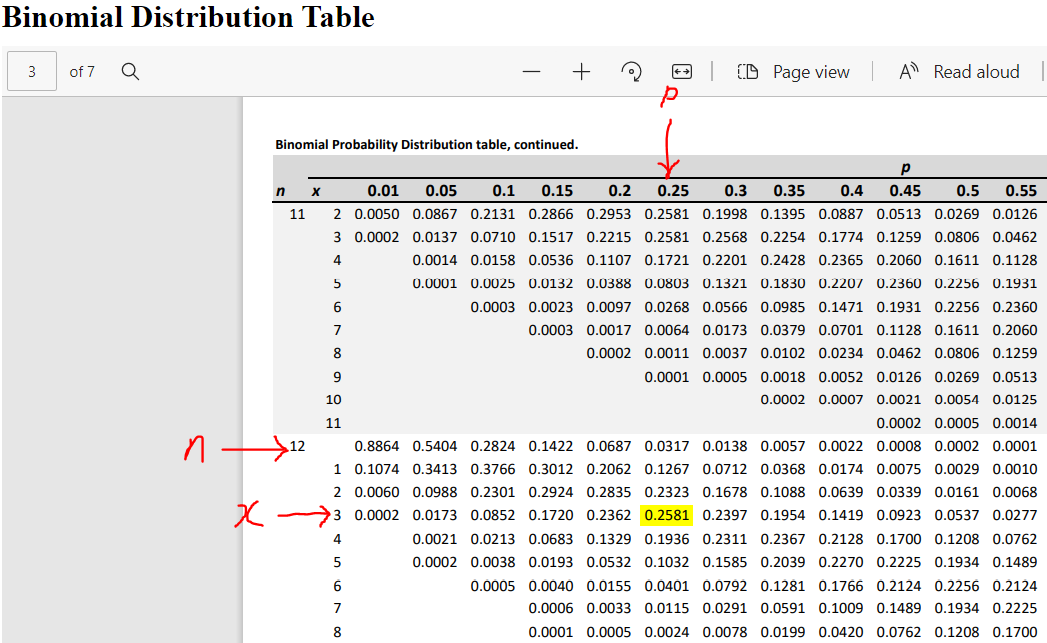
Number 1

$ P(x = 3) = 0.2581 \\[3ex] P(x = 3) \approx 0.258 $
(2.) Be Good University admits students into its medical program either by merit or by affirmative action (also known as positive discrimination)
Research has shown that the graduation rate for students admitted by affirmative action is 96%
(a.) Determine the probability that at least 14 of it's 15 randomly selected admitted students graduate from it's medical school. Round to 3 decimal places
(b.) Will this probability apply if 14 of those selected students were not chosen at random?


First Method: Binomial Distribution Formulas

$ n = 15 \\[3ex] p = 96\% = \dfrac{96}{100} = 0.96 \\[5ex] q = 1 - 0.96 = 0.04 \\[3ex] (a.) \\[3ex] P(at\;\;least\;\;14) \\[3ex] = P(\ge 14) \\[3ex] = P(14) + P(15) \\[3ex] P(14) = C(15, 14) * 0.96^{14} * 0.04^{15 - 14} \\[3ex] P(14) = C(15, 14) * 0.96^{14} * 0.04^1 \\[3ex] P(14) = 15 * 0.5646733124 * 0.04 \\[3ex] P(14) = 0.3388039874 \\[3ex] P(15) = C(15, 15) * 0.96^{15} * 0.04^{15 - 15} \\[3ex] P(15) = 1 * 0.5420863799 * 0.04^0 \\[3ex] P(15) = 1 * 0.5420863799 * 1 \\[3ex] P(15) = 0.5420863799 \\[3ex] \implies \\[3ex] P(\ge 14) = 0.3388039874 + 0.5420863799 \\[3ex] P(\ge 14) = 0.8808903673 \\[3ex] P(\ge 14) \approx 0.881 \\[3ex] $ (b.) No
This probability will not apply for students not selected at random
0.881 is the probability that 14 of the 15 randomly selected students graduated.
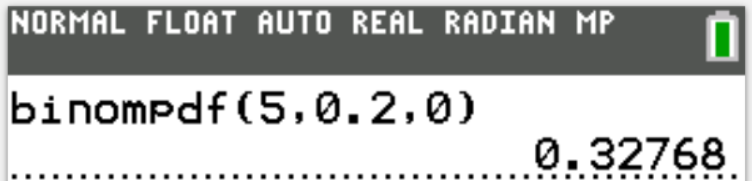
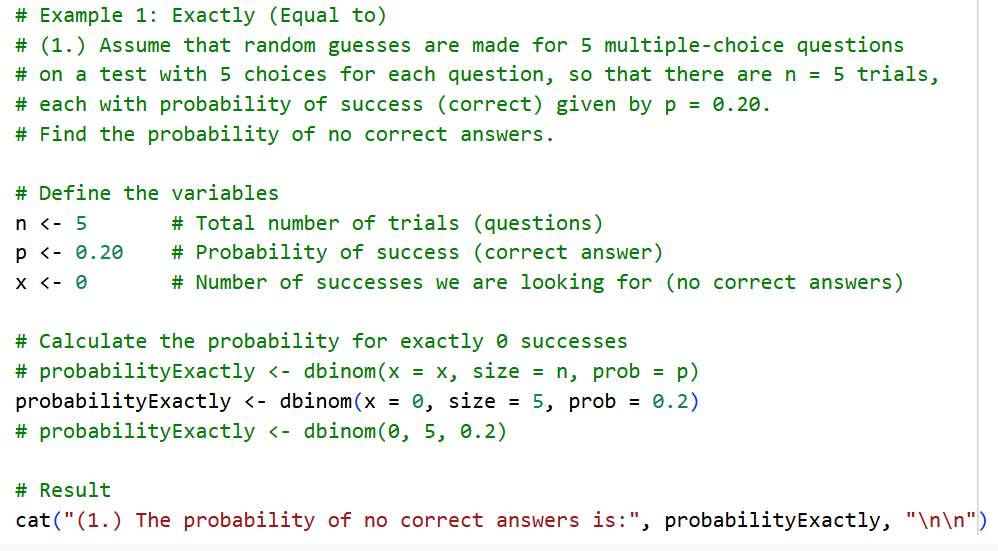
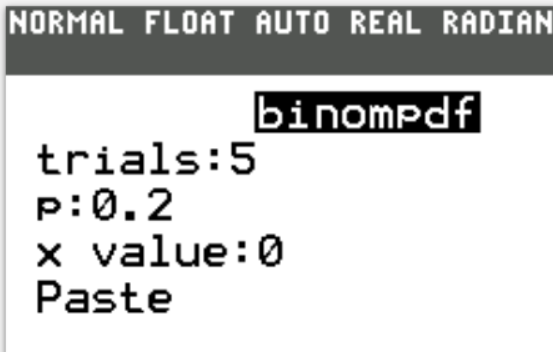
(3.) Assume that random guesses are made for 5 ​multiple-choice questions on a test with 5 choices for each​ question, so that there are n = 5 ​trials, each with probability of success​ (correct) given by p = 0.20.
Find the probability of no correct answers.


First Method: Binomial Distribution Formulas

$ n = 5 \\[3ex] p = 0.2 \\[3ex] q = 1 - p \\[3ex] q = 1 - 0.2 \\[3ex] q = 0.8 \\[3ex] P(x = 0) \\[3ex] = C(5, 0) * 0.2^0 * 0.8^{5 - 0} \\[3ex] ........................................................ \\[3ex] C(5, 0) = \dfrac{5!}{(5 - 0)! * 0!} \\[5ex] = \dfrac{5!}{5! * 0!} \\[5ex] = \dfrac{5!}{5! * 1} \\[5ex] = \dfrac{5!}{5!} \\[5ex] = 1 \\[3ex] ........................................................ \\[3ex] = 1 * 1 * 0.8^5 \\[4ex] = 1 * 0.32768 \\[3ex] = 0.32768 \\[3ex] $ Second Method: Texas Instrument Calculator

Number 3a
Number 3b

Third Method: R Programming

Number 3c
(4.) (a.) Calculate the mean and standard deviation for the number of students born on the 27th day of June for classes of 246 students. Ignore leap years. Round to 6 decimal places as needed.
(b.) Would 2 be an unusually high number of individuals who were born on the 27th day of June?


$ 1\;\;year = 365\;\;days \\[3ex] 27th\;\;June = 1\;\;day \\[3ex] n = 146 \\[3ex] p = \dfrac{1}{365} = 0.002739726027 \\[5ex] q = 1 - 0.002739726027 = 0.997260274 \\[3ex] (a.) \\[3ex] \mu = n * p \\[3ex] \mu = 246(0.002739726027) \\[3ex] \mu = 0.6739726027 \\[3ex] \mu \approx 0.673973 \\[3ex] \sigma = \sqrt{n * p * q} \\[3ex] \sigma = \sqrt{246 * 0.002739726027 * 0.997260274} \\[3ex] \sigma = \sqrt{0.6721261025} \\[3ex] \sigma = 0.8198329723 \\[3ex] \sigma \approx 0.819833 \\[3ex] (b.) \\[3ex] Minimum\;\;usual\;\;value \\[3ex] = \mu - 2\sigma \\[3ex] = 0.6739726027 - 2(0.8198329723) \\[3ex] = 0.6739726027 - 1.639665945 \\[3ex] = -0.9656933419 \\[3ex] Maximum\;\;usual\;\;value \\[3ex] = \mu + 2\sigma \\[3ex] = 0.6739726027 + 2(0.8198329723) \\[3ex] = 0.6739726027 + 1.639665945 \\[3ex] = 2.313638548 \\[3ex] Because \\[3ex] -0.9656933419 \le 2 \le 2.313638548 \\[3ex] $ 2 is within the range of the usual values.
Hence, it is not unusual to notice 2 students who were born on the 27th day of June.
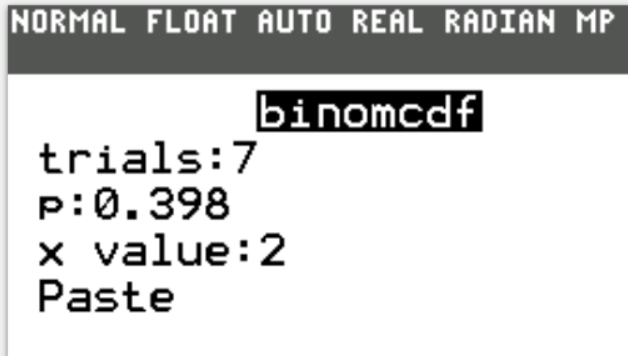
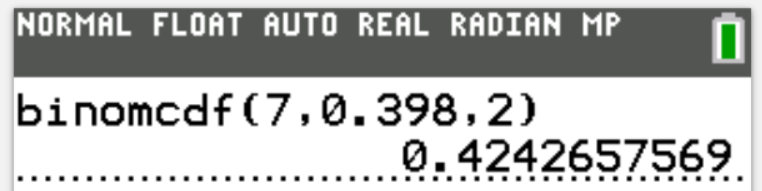
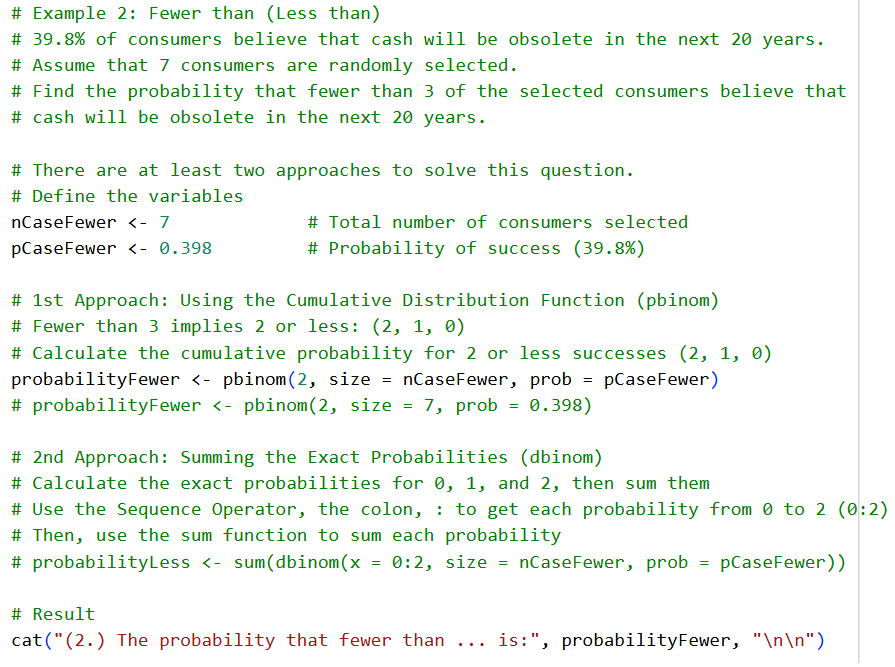
(5.) 39.8% of consumers believe that cash will be obsolete in the next 20 years.
Assume that 7 consumers are randomly selected.
Find the probability that fewer than 3 of the selected consumers believe that cash will be obsolete in the next 20 years.


1st Approach: Binomial Distribution Formula

$ n = 7 \\[3ex] p = 39.8\% = \dfrac{39.8}{100} = 0.398 \\[5ex] q = 1 - p \\[3ex] q = 1 - 0.398 \\[3ex] q = 0.602 \\[5ex] \text{P(fewer than 3)} = P(\lt 3) \\[3ex] = P(x = 0) + P(x = 1) + P(x = 2) \\[3ex] ...................................................... \\[3ex] P(x = 0) = C(7, 0) * 0.398^0 * 0.602^{7 - 0} \\[4ex] = 0.0286533522 \\[3ex] P(x = 1) = C(7, 1) * 0.398^1 * 0.602^{7 - 1} \\[4ex] = 0.1326050488 \\[3ex] P(x = 2) = C(7, 2) * 0.398^2 * 0.602^{7 - 2} \\[4ex] = 0.2630073559 \\[3ex] ...................................................... \\[3ex] = 0.0286533522 + 0.1326050488 + 0.2630073559 \\[3ex] = 0.4242657569 \\[3ex] $ 2nd Approach: Texas Instrument Calculator

Number 5a
Number 5b

3rd Approach: R Programming

Number 5c
(6.) 21% of the laptops produced by TechGuys Inc. are claimed to be red in color.
A sample of 100 laptops are randomly selected.
(a.) Calculate the mean and standard deviation of the number of red laptops in the sample of 100 laptops. Round to 1 decimal place as needed.
(b.) A random sample of 100 laptops contains 32 red laptops. Is this result unusual? Is the claimed rate of 21% wrong?


$ n = 100 \\[3ex] p = 21\% = \dfrac{21}{100} = 0.21 \\[5ex] q = 1 - 0.21 = 0.79 \\[3ex] (a.) \\[3ex] \mu = n * p \\[3ex] \mu = 100(0.21) \\[3ex] \mu = 21 \\[3ex] \sigma = \sqrt{n * p * q} \\[3ex] \sigma = \sqrt{100(0.21)(0.79)} \\[3ex] \sigma = \sqrt{16.59} \\[3ex] \sigma = 4.073082371 \\[3ex] \sigma \approx 4.1 \\[3ex] (b.) \\[3ex] Minimum\;\;usual\;\;value \\[3ex] = \mu - 2\sigma \\[3ex] = 21 - 2(4.073082371) \\[3ex] = 21 - 8.146164742 \\[3ex] = 12.85383526 \\[3ex] Maximum\;\;usual\;\;value \\[3ex] = \mu + 2\sigma \\[3ex] = 21 + 2(4.073082371) \\[3ex] = 21 + 8.146164742 \\[3ex] = 29.14616474 \\[3ex] 32 \gt 29.14616474 \\[3ex] $ The result is unusual
The claimed rate of 21% is probably wrong
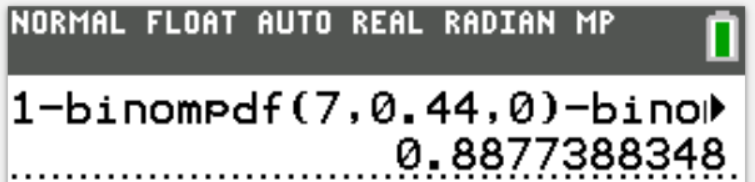
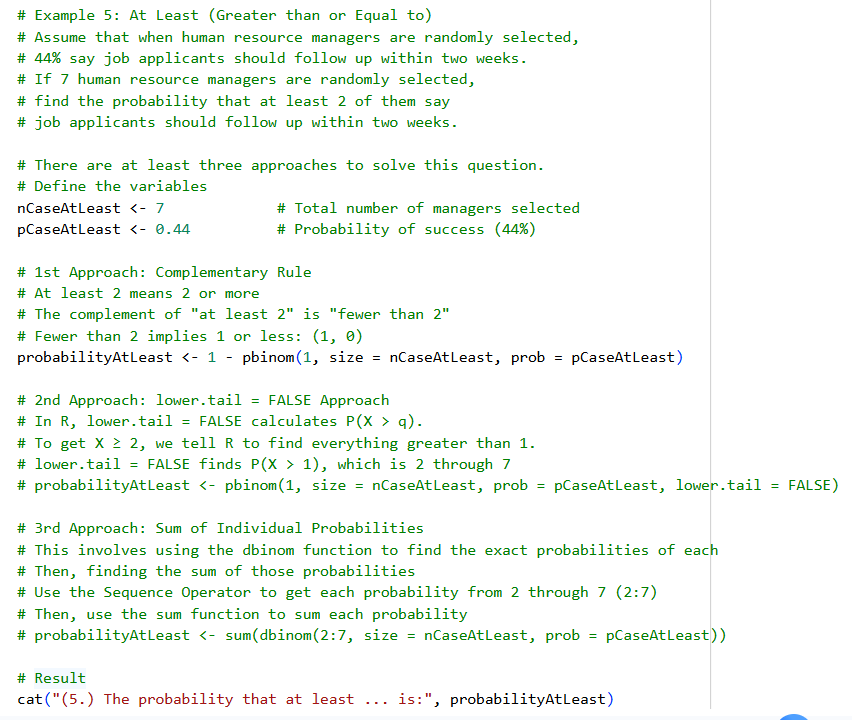
(7.) Assume that when human resource managers are randomly​ selected, 44​% say job applicants should follow up within two weeks.
If 7 human resource managers are randomly​ selected, find the probability that at least 2 of them say job applicants should follow up within two weeks.


1st Approach: Binomial Distribution Formula

$ n = 7 \\[3ex] p = 44\% = \dfrac{44}{100} = 0.44 \\[5ex] q = 1 - p \\[3ex] q = 1 - 0.44 \\[3ex] q = 0.56 \\[5ex] \text{P(at least 2)} = P(\ge 2) \\[3ex] = 1 - P(\lt 2)...\text{Complementary Rule} \\[3ex] = 1 - [P(x = 0) + P(x = 1)] \\[3ex] ...................................................... \\[3ex] P(x = 0) = C(7, 0) * 0.44^0 * 0.56^{7 - 0} \\[4ex] = 0.0172709485 \\[3ex] P(x = 1) = C(7, 1) * 0.44^1 * 0.56^{7 - 1} \\[4ex] = 0.0949902167 \\[3ex] ...................................................... \\[3ex] = 1 - (0.0172709485 + 0.0949902167) \\[3ex] = 1 - 0.1122611652 \\[3ex] = 0.8877388348 \\[3ex] $ 2nd Approach: Texas Instrument Calculator

Number 7a

3rd Approach: R Programming

Number 7b
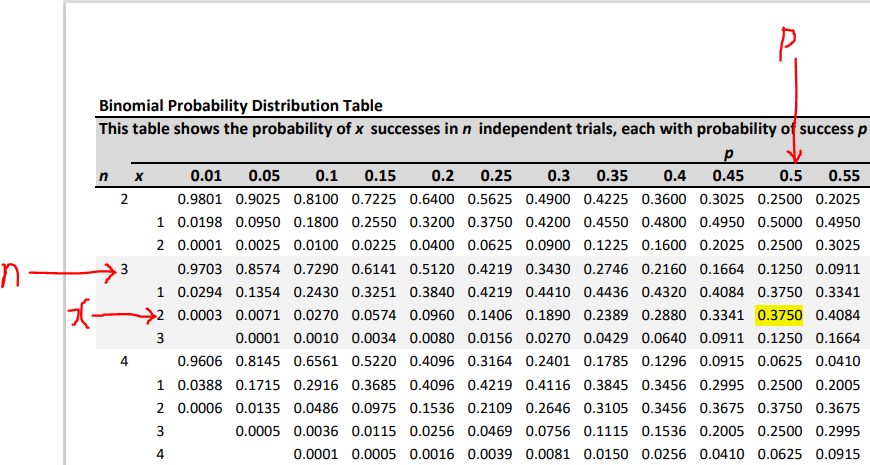
(8.) ACT In 3 fair coin tosses, what is the probability of obtaining exactly 2 tails?
(Note: In a fair coin toss, the 2 outcomes: heads and tails, are equally likely.)

$ F.\;\; \dfrac{1}{3} \\[5ex] G.\;\; \dfrac{3}{8} \\[5ex] H.\;\; \dfrac{1}{2} \\[5ex] J.\;\; \dfrac{2}{3} \\[5ex] K.\;\; \dfrac{7}{8} \\[5ex] $

We can solve this question in at least two ways.
Use any approach you prefer.

First Method: Binomial Distribution Formulas

$ Fair\;\;coin = 2 \;\;faces = H,\;\;T \\[3ex] P(T) = p = success = \dfrac{1}{2} \\[5ex] P(H) = q = failure = 1 - p = 1 - \dfrac{1}{2} = \dfrac{1}{2} \\[5ex] Tossed\;\;3\;\;times \rightarrow n = 3 \\[3ex] Exactly\;\;2T \implies \;\;x = 2T \\[3ex] P(exactly\;\;2T) = P(x = 2) \\[3ex] P(x = 2) = C(3, 2) * 0.5^2 * 0.5^{3 - 2} \\[3ex] P(x = 2) = C(3, 2) * 0.5^2 * 0.5^1 \\[3ex] C(3, 2) = \dfrac{3!}{(3 - 2)! * 2!} \\[5ex] = \dfrac{3 * 2!}{1! * 2!} \\[5ex] = 3 \\[3ex] \implies \\[3ex] P(x = 2) \\[3ex] = 3 * 0.25 * 0.5 \\[3ex] = 0.375 \\[3ex] = \dfrac{375}{1000} \\[5ex] = \dfrac{15}{40} \\[5ex] = \dfrac{3}{8} \\[5ex] $ Second Approach: Punnett Square
The sets containing exactly 2 tails are indicated in red

Sample Space for Three Tosses of a Fair Coin
Two Tosses in the Column and One Toss in the Row
$One\:\:Toss\:\:\rightarrow$
$Two\:\:Tosses\:\:\downarrow$
$H$ $T$
$HH$ $HHH$ $HHT$
$HT$ $HTH$ $\color{red}{HTT}$
$TH$ $THH$ $\color{red}{THT}$
$TT$ $\color{red}{TTH}$ $TTT$

$ n(exactly\;\;2\;\;tails) = 3 \\[3ex] n(S) = 4 * 2 = 8 \\[3ex] P(exactly\;\;2\;\;tails) \\[3ex] = \dfrac{n(exactly\;\;2\;\;tails)}{n(S)} \\[5ex] = \dfrac{3}{8} \\[5ex] $ Third Method: Binomial Distribution Tables

Number 8

$ P(exactly\;\;2T) \\[3ex] = P(x = 2) \\[3ex] = 0.3750 \\[3ex] = \dfrac{375}{1000} \\[5ex] = \dfrac{15}{40} \\[5ex] = \dfrac{3}{8} $
(9.) When purchasing bulk orders of​ batteries, a toy manufacturer uses this acceptance sampling​ plan: Randomly select and test 35 batteries and determine whether each is within specifications.
The entire shipment is accepted if at most 3 batteries do not meet specifications.
A shipment contains 3000 ​batteries, and 2​% of them do not meet specifications.
What is the probability that this whole shipment will be​ accepted?
Will almost all such shipments be​ accepted, or will many be​ rejected?


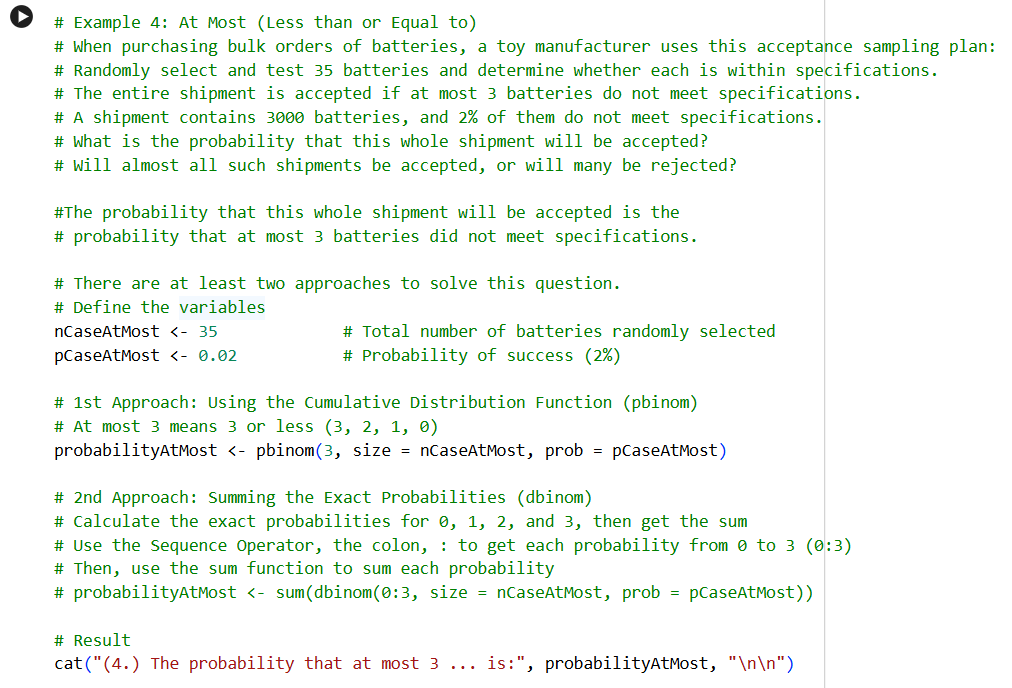
The probability that this whole shipment will be​ accepted is the probability that at most 3 batteries did not meet specifications.

1st Approach: Binomial Distribution Formula

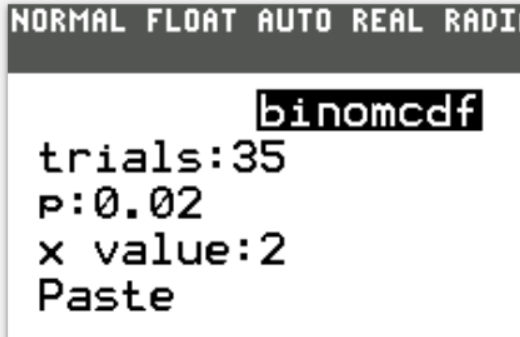
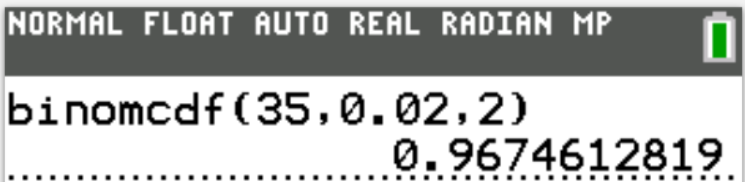
$ n = 35 \\[3ex] p = 2\% = \dfrac{2}{100} = 0.02 \\[5ex] q = 1 - p \\[3ex] q = 1 - 0.02 \\[3ex] q = 0.98 \\[5ex] \text{P(at most 2)} = P(\le 2) \\[3ex] = P(x = 0) + P(x = 1) + P(x = 2) \\[3ex] ...................................................... \\[3ex] P(x = 0) = C(35, 0) * 0.02^0 * 0.98^{35 - 0} \\[4ex] = 0.4930746206 \\[3ex] P(x = 1) = C(35, 1) * 0.02^1 * 0.98^{35 - 1} \\[4ex] = 0.3521961576 \\[3ex] P(x = 2) = C(35, 2) * 0.02^2 * 0.98^{35 - 2} \\[4ex] = 0.1221905037 \\[3ex] ...................................................... \\[3ex] = 0.4930746206 + 0.3521961576 + 0.1221905037 \\[3ex] = 0.9674612819 \\[3ex] $ 2nd Approach: Texas Instrument Calculator

Number 9a

Number 9b

3rd Approach: R Programming

Number 9c
(10.)


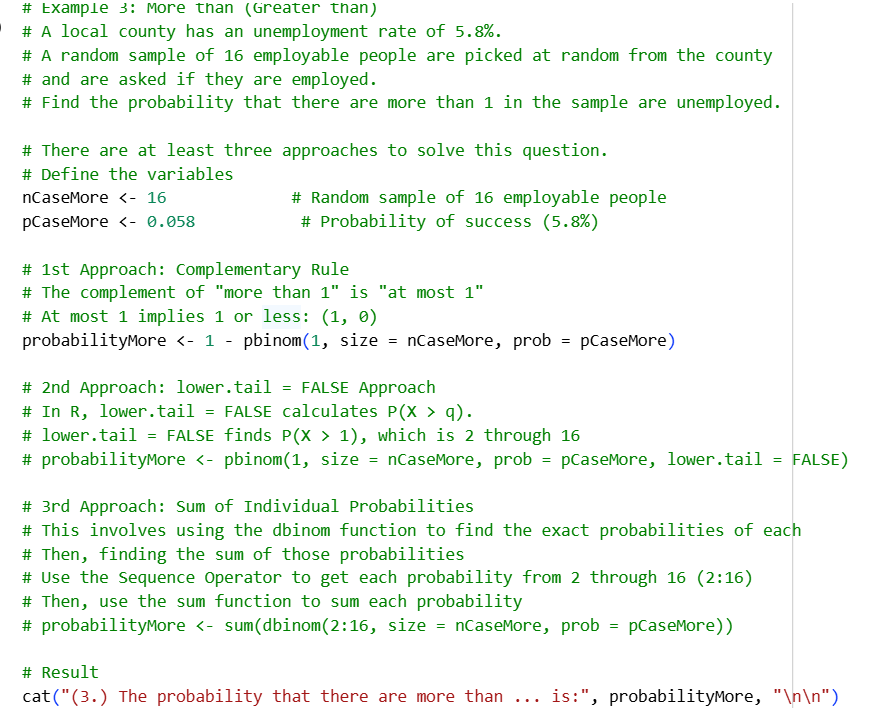
(11.) A local county has an unemployment rate of 5.8%.
A random sample of 16 employable people are picked at random from the county and are asked if they are employed.
Find the probability that there are more than 1 in the sample are unemployed.


1st Approach: Binomial Distribution Formula

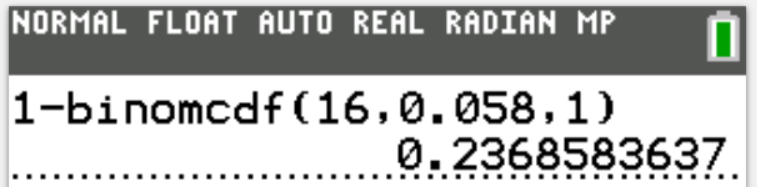
$ n = 16 \\[3ex] p = 5.8\% = \dfrac{5.8}{100} = 0.058 \\[5ex] q = 1 - p \\[3ex] q = 1 - 0.058 \\[3ex] q = 0.942 \\[5ex] \text{P(more than 1)} = P(\gt 1) \\[3ex] = 1 - P(\le 1)...\text{Complementary Rule} \\[3ex] = 1 - [P(x = 0) + P(x = 1)] \\[3ex] ...................................................... \\[3ex] P(x = 0) = C(16, 0) * 0.058^0 * 0.942^{16 - 0} \\[4ex] = 0.3844274977 \\[3ex] P(x = 1) = C(16, 1) * 0.058^1 * 0.942^{16 - 1} \\[4ex] = 0.3787141378 \\[3ex] ...................................................... \\[3ex] = 1 - (0.3844274977 + 0.3787141378) \\[3ex] = 1 - 0.7631416355 \\[3ex] = 0.2368583645 \\[3ex] $ 2nd Approach: Texas Instrument Calculator

Number 11a

3rd Approach: R Programming

Number 11b
(12.)


(13.) WASSCE-FM In an examination, 60% of the candidates passed.
If 10 candidates are selected at random, find the probability that:
(a.) at least two of them failed
(b.) exactly half of them passed
(c.) at most two of them failed.


$ p = 60\% = \dfrac{60}{100} = 0.6...pass \\[5ex] q = 1 - 0.6 = 0.4...fail \\[3ex] n = 10 \\[3ex] (a.) \\[3ex] P(at\;\;least\;\;2\;\;failed) = 1 - P(less\;\;than\;\;2\;\;failed)...Complementary\;\;Events \\[3ex] $ But for this particular question (a.)
Because we are interested in finding fail
In the formula:
$p$ will be $0.4$ while $q$ will be $0.6$

$ P(x \ge 2) = 1 - (x \lt 2) \\[3ex] P(x \lt 2) = P(x = 0) + P(x = 1) \\[3ex] P(x = 0) = C(10, 0) * 0.4^{0} * 0.6^{10 - 0} \\[3ex] P(x = 0) = 1 * 1 * 0.6^{10} \\[3ex] P(x = 0) = 0.0060466176 \\[3ex] P(x = 1) = C(10, 1) * 0.4^1 * 0.6^{10 - 1} \\[3ex] P(x = 1) = 10 * 0.4 * 0.6^9 \\[3ex] P(x = 1) = 4 * 0.010077696 \\[3ex] P(x = 1) = 0.040310784 \\[3ex] \implies \\[3ex] P(x \lt 2) = 0.0060466176 + 0.040310784 \\[3ex] P(x \lt 2) = 0.0463574016 \\[3ex] \implies \\[3ex] P(at\;\;least\;\;2\;\;failed) = 1 - 0.0463574016 \\[3ex] P(at\;\;least\;\;2\;\;failed) = 0.9536425984 \\[3ex] (b.) \\[3ex] P(exactly\;\;half\;\;of\;\;them\;\;passed) = P(x = 5) \\[3ex] $ For this particular question (b.)
Because we are interested in finding pass
In the formula:
$p$ will be $0.6$ while $q$ will be $0.4$

$ P(x = 5) = C(10, 5) * 0.6^5 * 0.4^{10 - 5} \\[3ex] P(x = 5) = 252 * 0.07776 * 0.4^5 \\[3ex] P(x = 5) = 19.59552 * 0.01024 \\[3ex] P(x = 5) = 0.2006581248 \\[3ex] (c.) \\[3ex] P(at\;\;most\;\;2\;\;failed) = P(x = 0) + P(x = 1) + P(x = 2) \\[3ex] OR \\[3ex] P(at\;\;most\;\;2\;\;failed) = 1 - P(more\;\;than\;\;2\;\;failed)...Complementary\;\;Events \\[3ex] $ For this particular question (c.)
Did you notice we can solve it in more than one way?
Because we are interested in finding fail
In the formula:
$p$ will be $0.4$ while $q$ will be $0.6$
We have already found $P(x = 0)$ and $P(x = 1)$ in (a.)
So, let us go ahead and find $P(x = 2)$

$ P(x = 2) = C(10, 2) * 0.4^2 * 0.6^{10 - 2} \\[3ex] P(x = 2) = 45 * 0.16 * 0.6^8 \\[3ex] P(x = 2) = 7.2 * 0.01679616 \\[3ex] P(x = 2) = 0.120932352 \\[3ex] \implies \\[3ex] P(at\;\;most\;\;2\;\;failed) = P(x = 0) + P(x = 1) + P(x = 2) \\[3ex] = 0.0060466176 + 0.040310784 + 0.120932352 \\[3ex] = 0.1672897536 \\[3ex] OR \\[3ex] P(at\;\;most\;\;2\;\;failed) = 1 - P(more\;\;than\;\;2\;\;failed) \\[3ex] But:\;\;P(at\;\;least\;\;2\;\;failed) = P(x = 2) + P(more\;\;than\;\;2\;\;failed) \\[3ex] P(x = 2) + P(more\;\;than\;\;2\;\;failed) = P(at\;\;least\;\;2\;\;failed) \\[3ex] P(more\;\;than\;\;2\;\;failed) = P(at\;\;least\;\;2\;\;failed) - P(x = 2) \\[3ex] P(more\;\;than\;\;2\;\;failed) = 0.9536425984 - 0.120932352 \\[3ex] P(more\;\;than\;\;2\;\;failed) = 0.8327102464 \\[3ex] \implies \\[3ex] P(at\;\;most\;\;2\;\;failed) = 1 - 0.8327102464 \\[3ex] P(at\;\;most\;\;2\;\;failed) = 0.1672897536 $
(14.)


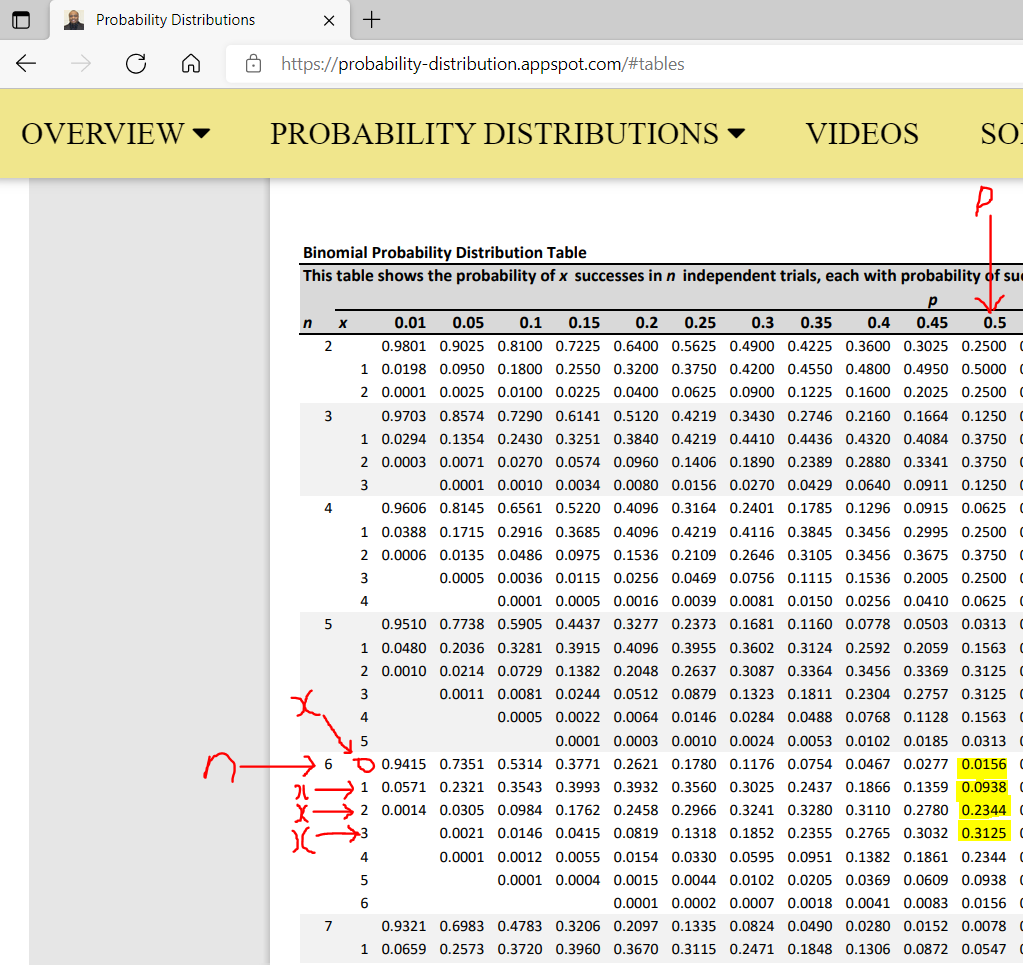
(15.) WASSCE-FM A fair coin is tossed 6 times.
Calculate the probability of obtaining at most three heads.


Student: Mr. C, we learned this under Probability
We did some examples.
Teacher: That is correct.
But remember the examples we did was for four tosses of a fair coin
Student: Yes, we used the Punnett Square
We can also use Tree Diagrams
Teacher: Okay, but using Punnett Square or Tree Diagram to solve 6 tosses of a fair coin will take more time
Student: But, it can still be done...
Teacher: Yes
Student: Can we use it to solve this question?
I understand the Punnett Square better
Teacher: We can...
But this question satisfies the requirements for a Binomial distribution
Let us solve it as a Binomial distribution first
Then, we can solve it using a Punnett Square


First Method: Binomial Distribution Formulas

$ Fair\;\;coin = 2 \;\;faces = H,\;\;T \\[3ex] P(H) = p = success = \dfrac{1}{2} \\[5ex] P(T) = q = failure = 1 - p = 1 - \dfrac{1}{2} = \dfrac{1}{2} \\[5ex] Tossed\;\;6\;\;times \rightarrow n = 6 \\[3ex] At\;\;most\;\;3H \implies x = 0H,\;\;x = 1H,\;\;x = 2H,\;\;x = 3H \\[3ex] P(at\;\;most\;\;3H) = P(x = 0) + P(x = 1) + P(x = 2) + P(x = 3) \\[3ex] P(x = 0) = C(6, 0) * 0.5^0 * 0.5^{6 - 0} \\[3ex] C(6, 0) = \dfrac{6!}{(6 - 0)! * 0!} \\[5ex] = \dfrac{6!}{6! * 1} \\[5ex] = 1 \\[3ex] \implies \\[3ex] P(x = 0) = 1 * 1 * 0.5^6 \\[3ex] P(x = 0) = 0.015625 \\[3ex] P(x = 1) = C(6, 1) * 0.5^1 * 0.5^{6 - 1} \\[3ex] P(x = 1) = C(6, 1) * 0.5^1 * 0.5^5 \\[3ex] C(6, 1) = \dfrac{6!}{(6 - 1)! * 1!} \\[5ex] = \dfrac{6 * 5!}{5! * 1} \\[5ex] = 6 \\[3ex] \implies \\[3ex] P(x = 1) = 6 * 0.5 * 0.03125 \\[3ex] P(x = 1) = 0.09375 \\[3ex] P(x = 2) = C(6, 2) * 0.5^2 * 0.5^{6 - 2} \\[3ex] P(x = 2) = C(6, 2) * 0.5^2 * 0.5^4 \\[3ex] C(6, 2) = \dfrac{6!}{(6 - 2)! * 2!} \\[5ex] = \dfrac{6 * 5 * 4!}{4! * 2 * 1} \\[5ex] = 3(5) \\[3ex] = 15 \\[3ex] \implies \\[3ex] P(x = 2) = 15 * 0.25 * 0.0625 \\[3ex] P(x = 2) = 0.234375 \\[3ex] P(x = 3) = C(6, 3) * 0.5^3 * 0.5^{6 - 3} \\[3ex] P(x = 3) = C(6, 3) * 0.5^3 * 0.5^3 \\[3ex] C(6, 3) = \dfrac{6!}{(6 - 3)! * 3!} \\[5ex] = \dfrac{6 * 5 * 4 * 3!}{3! * 3 * 2 * 1} \\[5ex] = 5(4) \\[3ex] = 20 \\[3ex] \implies \\[3ex] P(x = 3) = 20 * 0.125 * 0.125 \\[3ex] P(x = 3) = 0.3125 \\[3ex] \therefore P(at\;\;most\;\;3H) \\[3ex] = P(x = 0) + P(x = 1) + P(x = 2) + P(x = 3) \\[3ex] = 0.015625 + 0.09375 + 0.234375 + 0.3125 \\[3ex] = 0.65625 \\[3ex] $ Second Method: Punnett Square
6 tosses of a fair coin
6 tosses = 4 tosses + 2 tosses
At most 3 heads = 3 heads or less
This implies: 3 heads, 2 heads, 1 head, and 0 head
These will be in dark blue color
Sample Space for the Six Tosses of 1 Fair Coin

4 tosses in the Column and 2 tosses in the Row
$2\:\:Tosses\:\:\rightarrow$
$4\:\:Tosses\:\:\downarrow$
$HH$ $HT$ $TH$ $TT$
$HHHH$ $HHHHHH$ $HHHHHT$ $HHHHTH$ $HHHHTT$
$HHHT$ $HHHTHH$ $HHHTHT$ $HHHTTH$ $HHHTTT$
$HHTH$ $HHTHHH$ $HHTHHT$ $HHTHTH$ $HHTHTT$
$HHTT$ $HHTTHH$ $HHTTHT$ $HHTTTH$ $HHTTTT$
$HTHH$ $HTHHHH$ $HTHHHT$ $HTHHTH$ $HTHHTT$
$HTHT$ $HTHTHH$ $HTHTHT$ $HTHTTH$ $HTHTTT$
$HTTH$ $HTTHHH$ $HTTHHT$ $HTTHTH$ $HTTHTT$
$HTTT$ $HTTTHH$ $HTTTHT$ $HTTTTH$ $HTTTTT$
$THHH$ $THHHHH$ $THHHHT$ $THHHTH$ $THHHTT$
$THHT$ $THHTHH$ $THHTHT$ $THHTTH$ $THHTTT$
$THTH$ $THTHHH$ $THTHHT$ $THTHTH$ $THTHTT$
$THTT$ $THTTHH$ $THTTHT$ $THTTTH$ $THTTTT$
$TTHH$ $TTHHHH$ $TTHHHT$ $TTHHTH$ $TTHHTT$
$TTHT$ $TTHTHH$ $TTHTHT$ $TTHTTH$ $TTHTTT$
$TTTH$ $TTTHHH$ $TTTHHT$ $TTTHTH$ $TTTHTT$
$TTTT$ $TTTTHH$ $TTTTHT$ $TTTTTH$ $TTTTTT$

$ n(S) = 16 * 4 = 64 \\[3ex] Let\;\;E = At\;\;most\;\;3H = dark\;blue\;\;color \\[3ex] n(E) = 42 \\[3ex] P(E) = \dfrac{n(E)}{n(S)} \\[5ex] = \dfrac{42}{64} \\[5ex] = 0.65625 \\[3ex] $ Third Method: Binomial Distribution Tables

Number 15

$ P(at\;\;most\;\;3H) \\[3ex] = P(x = 0) + P(x = 1) + P(x = 2) + P(x = 3) \\[3ex] P(x = 0) = 0.0156 \\[3ex] P(x = 1) = 0.0938 \\[3ex] P(x = 2) = 0.2344 \\[3ex] P(x = 3) = 0.3125 \\[3ex] \implies \\[3ex] P(at\;\;most\;\;3H) \\[3ex] = 0.0156 + 0.0938 + 0.2344 + 0.3125 \\[3ex] = 0.6563 $
(16.)


(17.)


(18.)


(19.)


(20.)